Bassoues
A very old community, Bassoues probably existed well before the 10th century.
The history of Bassoues is closely linked to that of a legendary prince whom the centuries have named Saint Fris.
It was in fact in 732, at a place known today as "Le plateau de l'étendard", that Fris, son of Rabbod, Duke of Frise, and nephew of Charles Martel, converted to the Catholic religion, planted his banner in Bassoues to rally the Franks, who had been defeated by the Saracens on the heights of Lupiac.
Victory was won, but the sacrifice was immense. Fris was shot by a fatal arrow and died near the bridge that has since been called the "Christian Bridge". His body, secretly buried, was miraculously discovered by a shepherd some two centuries later.
Miracles having been performed, a sarcophagus was erected to house the holy relics and a church was built in honour of the illustrious martyred warrior.

In November 1020, Raymond, Lord of Bassoues, donated the church of St Fris to the monks of Pessan, on condition that a Benedictine convent be built near the saint's tomb:the Basilica of St Fris. The monks occupied this convent, but it was devastated several times and the monks were mistreated. In 1270, with only one monk occupying the site, it was given to the Archbishop of Auch, Amanieu II d'Armagnac.
In 1283, Bassoues was named the parish of Saint Fris.
Having become Lord of Bassoues, AMANIEU II gave the inhabitants letters of custom in 1295, shortly after the Bastide was founded.
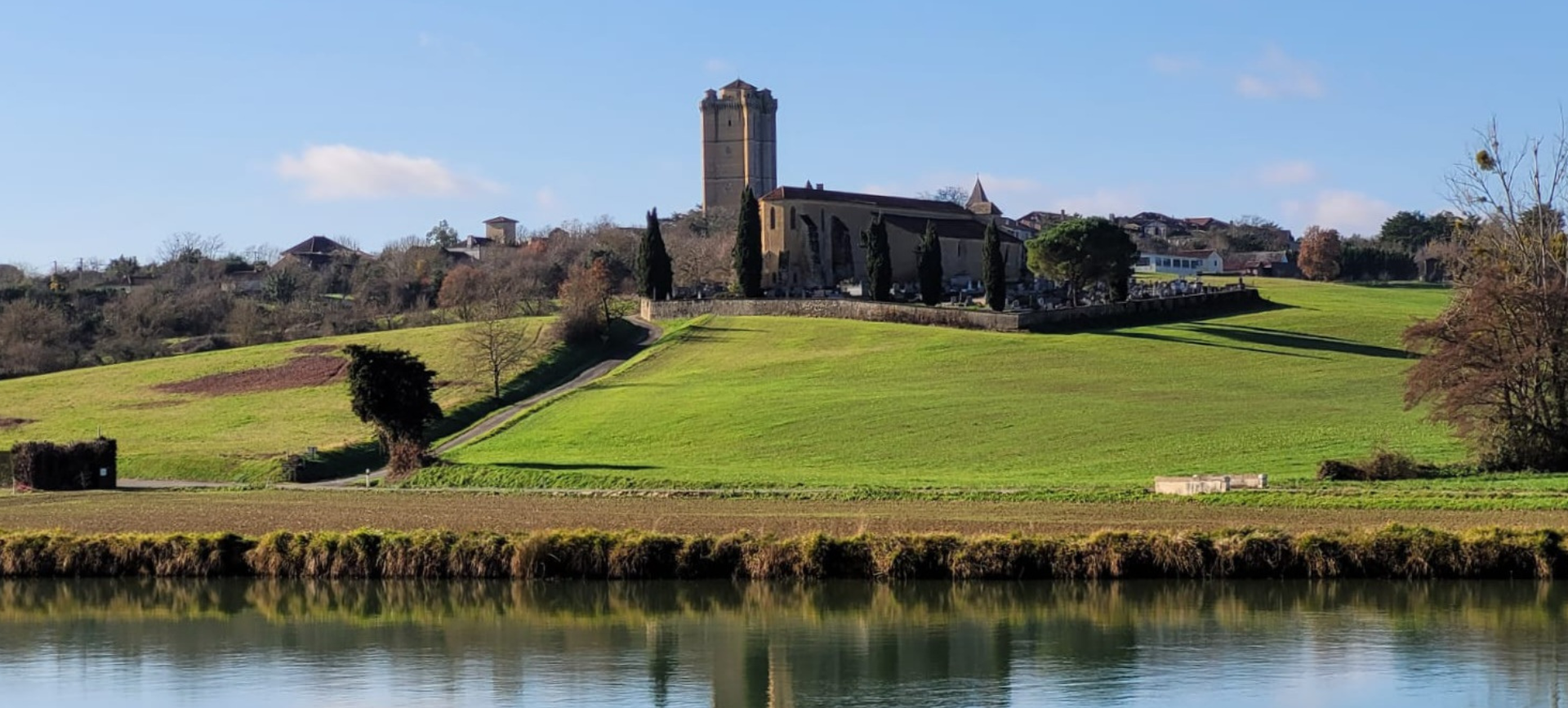
His successor, Archbishop and Cardinal Arnaud AUBERT, nephew of Pope INNOCENT VI, built the surrounding walls, his residential castle and the keep, which was completed in 1371.
It was not until 1510 that the Church of Notre-Dame, located in the heart of the bastide, was consecrated as a parish church.

It was in the 16th century that the Cardinal of Clermont-Lodève had the covered market built and embellished the St Fris basilica with two Renaissance portals.
Bassoues is now a charming little village with a typically medieval character, with its fortifications, its 14th-century keep, its beautiful market hall, its basilica and the legend of Saint Fris, which has lulled its inhabitants for centuries.

You may also like